Theme Layout

Boxed or Wide or Framed

Theme Translation

Display Featured Slider

Featured Slider Styles

Display Grid Slider

Grid Slider Styles

Display Trending Posts

Display Author Bio

Display Instagram Footer

Powered by Blogger.

Display Author Bio

Theme Layout

Featured Posts

Grid Posts Slider

Trending Posts

About Author Bio

Recent Posts

Twitter Feed

Flickr Gallery

georgialoustudios

Search This Blog

favorite movie

Featured Posts

Grid Posts Slider

Trending Posts

About Author Bio

Recent Posts

Twitter Feed

Grid Slider Styles

Flickr Gallery

georgialoustudios

Grid Slider Styles

Display Author Bio

Theme Layout

Showing posts with label Interactive notebooks. Show all posts

Friday, October 21, 2016

THE BEST WAY TO SET UP INTERACTIVE WRITING NOTEBOOKS

THE BEST WAY TO SET UP INTERACTIVE WRITING NOTEBOOKS


I've used writing notebooks for several years and have made changes along the way to find the best possible way to use them. This post will show how to set up your notebook!  There is a video link at the bottom too!

the best way to set up interactive writing notebooks


(You will find some Amazon affiliate links on this page. The small commission I make goes back into my blog so I can provide teachers with ideas and activities for their classrooms!)


A. Decorate the Outside Cover


Use a composition notebook, create a personalized outside cover, and seal it with packaging tape.  This is a great homework assignment!

Click to purchase from Amazon


personalize the cover of notebook  personalize the cover of the notebook


B.  Create a Table of Contents and Page Numbers

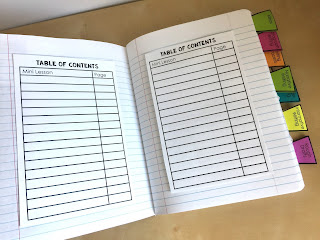
Start a table of contents on the first page.  Save the first 4 pages for Table of Contents.  As students add their notes, they number their pages and keep track on the Table of Contents page!  We used colorful dot labels for page numbers.

record the lesson and page for the table of contents

example of interactive writing notebook pages


Colorful dots:  Any 3/4 inch dot labels will work, but the ones below are my FAVORITE because they offer 10 different colors. 


lists skills and pages for table of contents  

C. Tabs and Cover Sheets

To make tabs for notebooks, there are 3 options.  Post Its, Redi-Tags or TABS from my store.  (Please don't purchase tabs from my store if you have already purchased an Interactive Writing Notebook.  They have been added to that resource and you can download it from your purchases!)

1.    2.       


3.  tabs for ideas, paragraph writing, narrative writing, opinion writing, informative writing with  

Create tabs (and covers)

Ideas- 3 pages using front and back.

Paragraph Writing-  5 pages using front and back.

Writing Process- 1 page using front and back.

Narrative Writing- 14 pages using front and back.

Opinion Writing- 8 pages using front and back.

Informative Writing- 11 pages using front and back.

Rough Drafts-  the rest of the notebook

Take notes in all sections except rough drafts.  Use this section to create stories, revise and edit. Then write final drafts on a separate (final copy) paper and place them in writing porfolios.
  
create a cover sheet for ideas in writingcreate a cover sheet and tab for paragraph writing in notebook

The least expensive way:
I know all about teaching on a budget.  Make Tabs with Post Its- This is the least expensive way. Collect as many colors of Post-It notes as needed for the amount of tabs you want to create and cut them in strips. Fold it over once. Then tape each color strip in the notebook.  Use clear packaging tape and place it on both sides of the tab and both sides of the page so it looks like it is a laminated piece.

easy way to create tabs for interactive notebooks

Redi Tags are easier but more expensive than Post Its.


D.  3-Prong Pocket Folders-  2 per student


1.  Student Resource Folder:  Place FREE spelling dictionary and any resources neccessary for students to use during writing workshop.   Place the resource pages in the fasteners and the spelling dictionary in one of the pockets in the folder.

give students resources for writing workshop


If you need a Resource Guide, click below.  

student resources for writing workshop

Free Spelling Dictionary!

for writing workshop


2.  Writing Portfolios:  Use the second folder for final copies.
Collect everything that they have published throughout the year! Poems, stories, writing across the curriculum, bulletin board pieces, etc. Place them in a folder with brass fasteners. At the end of the year, they get to keep their final product! It is a great end-of-year gift! Another idea is to set them out on table during parent/teacher conferences so parents have something to look at while they are waiting.

folder filled with final copy or published copies of student work


Here is a video to show you how to set up your notebooks!  Click on pic below!

a video link to how to set up interactive notebooks


I hope these ideas helped you organize student notebooks!  If you are looking for a step-by-step writing approach TO MOTIVATE STUDENTS AND BOOST TEST SCORES that includes anchor charts, forms, tracking, model samples, printables, rubrics, slides, posters, etc. etc. Check out the all inclusive writing bundle:

step-by-step writing program


Read more »
Unknown
0 Comments

Tuesday, June 7, 2016

Sunday, December 27, 2015

Writing Mini Lesson #34- Usage

Writing Mini Lesson #34- Usage


    Welcome to a lesson from our Writing Mini Lesson Series!

I hope you learned a lot from our mini lesson #33 -CUPS to Edit- Capitalization. This lesson will focus on USAGE. A reminder- CUPS means Capitalization, Usage, Punctuation, Spelling.

USAGE covers the following rules:

1.  Subject-Verb Agreement
2.  Double Negatives
3.  Complete Sentences
4.  Run-On Sentences
5.  Verb Forms and Tenses


First, review the following rules:  Common Core Standards:  L.4.1.b,  L.4.1.f

1.  Subject-Verb Agreement-  Singular subjects need singular verbs, and plural subjects need plural verbs.
     A.  Singular Verbs- is, was, has, had   (Ex.  The bee is buzzing.)

     B.  Plural Verbs-  are, were, have, had  (Ex.  The bees are buzzing.)

2.  Double Negatives-  Do not use two or more words that mean "no" in the same sentence. 
     No words-  no, not, never, nothing, no where, no one, nobody

3.  Complete Sentences-  Sentences need a subject and predicate.  

     A.  Subject-  Tells whom or what-  (Ex.  My mom)

     B.  Predicate- What the subject does (helps me)

     C.  Fragment-  Missing a subject or predicate- (The pictures in the book.)

     D.  Complete-  (The pictures in the book are colorful.)

4.  Run-On Sentences-  Two complete sentences that run together.  (Tristan plays soccer they won the game.)  To correct:  

     A.  Two Sentences:  Tristan plays soccer.  They won the game.

     B.  Compound Sentences:  Tristan plays soccer, and they won the game.

5.  Verb Forms and Tenses 


Next, have students take notes in their writing notebooks.


Then correct a sample together.

 Find  8 usage  mistakes
         Crash!  Smash  Shatter!  The window peicesis scattered all over the ground.   Mom was upset about the mess.  I was so worryedthat our dog, Ralphiemay have gotten through the window and runaway. 
          We started investigating and found many clues.  I noticeedthat a  huge shelf fell and shattered the window.  Mom saw that our hot Boston Market dinner that she left out to cool was gone.  Ralphiewill run in the room and was so excited   He seemmedto be licking his chops.  I squeezed him and said  There you are boy
         Then my mom looked around and questioned  “Are those footprints?”  We realizing they were not paw prints.  They were human shoe prints!   They were muddy messy and as big as giants!    My brave mom decided to follow them out the back door.  I was petrifying and my heart skiped a beat!
          The next moment, it was leading us to the shed.  I was scared.  Mom qietlycreaked open the door.  My heart was thump so loud it sounded like a beating drum as I looked in.  I  jumped back.   I absolutely cant never beleivewhat I saw!  Was it human?
          A big burly man turned around and I thought I would pass out.  It was my Uncle Joe!  He came over to drop something off he  noticed the broken window.  He was in the shed to find toolesto cover it up.   I was so happy to see it was him that I ran over I gave him a big bear hug!   I can’t believe Ralphiecaused so much commotion to get to our dinner.  What will he do next?


Answers:


 Find  8 usage  mistakes
         Crash!  Smash  Shatter!  The window peices are scattered all over the ground.   Mom was upset about the mess.  I was so worryedthat our dog, Ralphiemay have gotten through the window and runaway. 
          We started investigating and found many clues.  I noticeedthat a  huge shelf fell and shattered the window.  Mom saw that our hot Boston Market dinner that she left out to cool was gone.  Ralphieranin the room and  was so excited   He seemmedto be licking his chops.  I squeezed him and said  There you are boy
         Then my mom looked around and questioned  “Are those footprints?”  We realizedthey were not paw prints.  They were human shoe prints!   They were muddy messy and as big as giants!    My brave mom decided to follow them out the back door.  I was petrifyedand my heart skiped a beat!
          The next moment, it was leading us to the shed.  I was scared.  Mom qietlycreaked open the door.  My heart was thumpingso loud it sounded like  a beating drum as I looked in.  I  jumped back.   I absolutely cant never believe what I saw!  Was it human?
          A big burly man turned around and I thought I would pass out.  It was my Uncle Joe!  He came over to drop something off andnoticed the broken window.  He was in the shed to find tooles to cover it up.   I was so happy to see it was him that I ran over and gave him a big bear hug!   I can’t believe Ralphiecaused so much commotion to get to our dinner.  What will he do next?


Last, give your students some independent practice.


     You are welcome to use these examples in your classroom with your students!

Next writing mini lesson #34-  CUPS-  Punctuation!

Like always, 

ROCK 'N' WRITE!!!!
     If you would rather have all of the these mini lessons (over 400 pages) in one spot along with tracking forms, goal forms, prompts, practice sheets, etc, etc. Click on the pic below! Boost those test scores with a year-long writing program!


Read more »
Unknown
0 Comments

Sunday, November 1, 2015

Writing Mini Lesson #32- CUPS to Edit

Writing Mini Lesson #32- CUPS to Edit


Now that your students have a creative title from writing mini lesson #31- Crafting a Title, the revising stages are finished. It is time to start editing! This mini lesson focuses on CUPS.


When in the revising stage, we "listened" for the errors. With CUPS, we "look" for errors. Get out those magnifying glasses! Oh yeah! Use magnifying glasses in class to support this step of the writing process. Students will take 5 days to edit their papers using CUPS.

1.  What is CUPS?
2.  Capitals
3.  Usage
4.  Punctuation
5.  Spelling


For CUPS, I ask students to use a different color pen than used for revising. If they want to use multiple colors, I am ok with that too. Whatever it takes for them to be excited about revising and editing, I take it! During the editing process, have a dictionary available!

The skills that should be covered for Grades 3-5 are the following:

Capitals- beginning of the sentence, I, proper nouns, titles, inside quotes.

Usage- subject-verb agreement, double negatives, sentence fragments, run-on sentences, verb forms and tenses, pronoun case forms.

Punctuation- End of sentences, commas in a series, quotations, combine sentences

Spelling Rules-

1.  Always put a u after a q. (quack, quiet)
2.  Every syllable has a vowel.
3.  The “soft” sound of c (s sound) or g (j sound) is usually foll0wed by i, y, or e. (city, gym)
4.  Write I before e except after c or when sounded like a. (thief, believe, ceiling, receive, neighbor, weigh)
5.  Spelling Rules for Adding Inflectional Endings to Words
A. Most words- Add the ending. (talk- talked, talking)
B. Words ending in a single vowel and consonant- Double the final consonant and add the ending. (stop- stopped, stopping)
C. Words ending in silent e- Drop the e before adding the ending. (bake, baked, baking)
D. Words end in a consonant and y- Change the y to and i then add the ending unless the ending is -ing. (hurry- hurried, hurrying)
E. Words that end in ss, ch, sh, zz, or x: Add –es (foxes, wishes)

After sharing the meaning of CUPS, have students add it to their notebooks. Look at this cutie and her cup!


I love how my students like to make their own way of having an interactive notebook. I told them to cut out the front of the cup and open it up to take notes. Then I said, "Unless you have another idea!" This student decided to cut out each of the CUPS and put it in the cup.


This student just wanted to make a little hole in the cup for notes. However they want to be creative is fine with me!


I have a friendly letter freebie in my store to help with CUPS! Click on the pic below!


Next writing mini lesson #33-  CUPS-  C for Capitalization!

Like always,

ROCK 'N' WRITE!!!!
If you would rather have all of the these mini lessons (over 400 pages) in one spot along with tracking forms, goal forms, prompts, practice sheets, etc, etc. Click on the pic below! Boost those test scores with a year-long writing program!


Read more »
Unknown
0 Comments

Follow @georgialoustudios