Theme Layout

Boxed or Wide or Framed

Theme Translation

Display Featured Slider

Featured Slider Styles

Display Grid Slider

Grid Slider Styles

Display Trending Posts

Display Author Bio

Display Instagram Footer

Powered by Blogger.

Display Author Bio

Theme Layout

Featured Posts

Grid Posts Slider

Trending Posts

About Author Bio

Recent Posts

Twitter Feed

Flickr Gallery

georgialoustudios

Search This Blog

favorite movie

Featured Posts

Grid Posts Slider

Trending Posts

About Author Bio

Recent Posts

Twitter Feed

Grid Slider Styles

Flickr Gallery

georgialoustudios

Grid Slider Styles

Display Author Bio

Theme Layout

Showing posts with label Reading. Show all posts

Saturday, January 7, 2017

An Easy Reading Response System for Accountability

An Easy Reading Response System for Accountability


Reading Response skills and strategies are important for students to have a better understanding of their reading.  Whether you are reading a chapter book together, assigning book groups, or allowing for independent reading for your students, responding to the text is crucial to a deeper comprehension of the text.  Students should not only respond to fiction, but also to nonfiction text.

keep students accountable


So what is an effective way for reading response AND keep your students accountable for their reading?  Reading Response Notebooks!  Use the following ideas for using reading response notebooks:
  
1.  Decide on what skills are necessary for your students.  Ideas may include:

Fiction:

Characterization
Setting Description
Problem Solving
Figurative Language
Sequence of Events
Text Illustration
Point of View of 2 Characters
Text Connection
Questioning
Summarizing

Nonfiction:

Explanation
Main Idea and Details
Vocabulary
Visuals
Meaningful Quote
Point of View
Text Connections
Questioning
Text Evidence
Summarize

2.  Next, decide on how many times you would like to assess each skill.
Once?  You can use response questions for a project where students need to complete them (fiction, nonfiction, or combination) by a due date.
Twice?  Model responses for the whole group reading, then assign the same response questions for their independent reading.
Quarterly?  Use the same response questions each quarter and track student progress.

3.  For each response, students should record the title of the text.  For fiction, also have them identify the genre.  For nonfiction, have them identify the source. (ex. newspaper article, website, book, etc.)

main idea reading skill


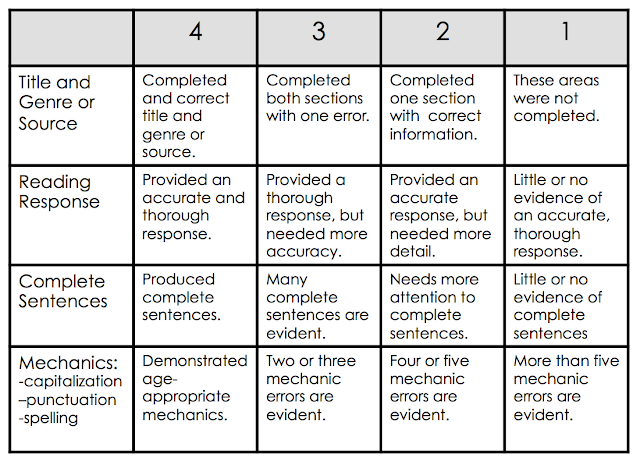
4.  Review the skill/strategy and your expectations with the students.  In my Reading Response Notebooks, I include 3 rubrics.  One for an individual skill, another for all of the fiction skills, and the third for all of the nonfiction skills.  Encourage students to write enough details to provide a thorough response.  Use a rubric to explain expectations!  This is an example for individual skill.


5.  After grading students' work, have them track their progress for each skill even if you only plan for them to respond once.  It will give you an overall view of areas they may need help in.  If you use them each quarter, it will show their progress in learning that skill or strategy.  This example is a quarterly tracking chart.  These are effective tools when conferencing with parents too.

fiction and nonfiction response questions tracking form


How do I put the notebooks together?

1.  Print a cover on white cardstock or have students create their own decoration for the cover.
2.  Have students color the cover.
3.  Use two different color cardstock, one for fiction and one for nonfiction.
4.  Add a tab for fiction and nonfiction.
5.  Print response pages or place enough paper for the amount of response you want for each category.  Click Here for response pages.
6.  Create a table of contents and/or tracking chart.
7.  Put the notebooks together:  Cover page, table of contents, tracking form, fiction cover page and printable, nonfiction cover page and printables, and rubric (optional).
8.  Hole punch the pages.
9.  Place them in a 3-prong folder that can support 24 pages or more if you are using them more than once.  My FAVORITE is Oxford Clear Report Covers.  http://amzn.to/2j9dIP3  


They fit 100 pages which works great for one time, semester, or quarterly assessments and are durable enough for reuse.  I love the clear front page.  I wouldn't recommend regular report covers with the plastic sliding bar becasue they are hard to maneuver.  A small binder would work too.

10.  Add tabs and waaaahlllllaaa!  You are ready for reading response!

cover page for reading response


If you would like all of this prepped for you with Common Core standards on each page, CLICK HERE.  This reading response notebook will save you time and provide your students with an abundance of both FICTION AND NONFICTION skills and stategies.  It can be used multiple times to help students get a clear understanding of each skill.  There are specific questions for each skill or strategy that guide your students to understand how to respond to that particular skill or strategy.

the best resource ever


Read more »
Unknown
0 Comments

Monday, October 3, 2016

October Books for Upper Elementary

October Books for Upper Elementary


Are you looking for great literature to introduce to your students in the month of October?  You will find some of my favorites for upper elementary students.  Read on for a summary and why they are my favorites!  Happy Haunted Reading!  CLICK ON EACH BOOK PICTURE TO FIND IT ON AMAZON!


1.  Bunnicula by Deborah and James Howe.


A chapter book:  4.2 reading level

Harold, the narrator of the story, is hysterical! He is just like my dog, Romeo, who begs for food 24-7! And Chester, the cat, oh my. My students and I fall off our chairs when reading about his shenanigans! He thinks that the new bunny in the house is a vampire and performs crazy acts to get rid of the vampire!  I love this character so much that I call my own cat Chester when he acts a little crazy.  Chester wears garlic around his neck, tries to pound the bunny with a steak..yes steak not stake, and wears a towel around his neck to look like a vampire cape to get everyone's attention. The poor bunny can't get a break so Harold steps in to help him. It is a must read! Teachers, there are so many different reading skills you can pull from this book.  The great thing about this book, is there is a series so my students ran to the library asking for the next book!

Bunnicula Series-  All of the Bunnicula Books

Howliday Inn
Bunnicula Strikes Again
The Celery Stalks at Midnight
Nighty Nightmare
Return to Howliday Inn
Bunnicula Meets Edgar Allan Crow


2.  The Ghost of Fossil Glen by Cynthia DeFelice


A chapter book:  Reading level 5.1


This has been my favorite read aloud for years!  My students begged and pleaded for me to keep reading each day.  It is so realistic that students can relate to it.  It is about eleven-year old Allie Nichols who loves climbing at Fossil Glen, which is dangerously steep and rocky.  As she is clinging to the side of a cliff, she hears a trusting voice to bring her down the cliff safely.  The mysterious thing is that there was NOBODY there!  As she begins to investigate, she realizes that some of her friends were not true friends and she decides to only confide in her long time friend Dub.  Allie continues to hear voices and is given clues to a mystery.  As Ali and Dub gets closer to discovering out the ghostly voice and clues, they realize they uncovered a very gruesome crime and they are now in danger!  Just like Bunnicula, this book has a series, so my students ran to the library to grab the next one!
The Ghost and Mrs. Hobbs
The Ghost of Cutler's Creek

3.  It's Halloween, I'm turning Green!  by Dan Gutman


A chapter book:  3.7 reading level

This book comes from the My Weird School series.  During trick-or-treating, A.J. and his group of friends plan to get enough candy to last them through the year.  They have to beware of the Halloween monster who is ready to steal all of their candy.  There are so many funny sayings and exaggerations!  What would happen if a kid ate a million hundred pounds of chocolate in one night?  I love all the words of imagery used to fill pictures of hillarious scenes in our minds!  It is an easy read with many new words and phrases.  The bonus content at the end of the book is motivating too!  It includes Halloween facts, a word search, puzzles and more.

4.  The Halloween Tree by Ray Bradbury


A chapter book: 4.7 reading level

This fast-paced tale is about eight boys dressed for Halloween who are meeting their friend Pipkin at a haunted house outside of town.  I love the black and white drawing to make it even more haunting.  The boys encounter Mr. Moundshroud and Pipkin gets swept away by something dark and eerie.  Mr. Moundshroud takes the boys on the tail of a kite through time to search for Pipkin and the meaning of Halloween.  It is saturated with great Halloween history including ancient Egypt, cavemen, persecution of witches in the Dark ages, gargoyles of Notre Dame, and catacombs of Mexico.  In the end each boy has to give up something (I don't want to spoil the story) to save Pipkin's life.


5.  Percy Jackson and the Olympians Book 4:  The Battle of the Labyrinth


A chapter book:  3.3 reading level

This book is full of humor, adventure, and heart-pounding events!  Percy Jackson reluctantly goes to a boring freshman orientation only to find shocking surprises of a mysterious mortal acquantance and demon cheerleaders!  Camp Half-Blood is no longer safe!  Percy and his demigod friends set out on a quest through an underground world to stop the invasion of Titan lord Krono's army.  This war between the Olympians and evil Kronos has many surprises and action twists as they try to avoid the time from running out!  My boys loved this book!


6. Tell Me a Scary Story..But Not Too Scary by Carl Reiner


A Picture Book: Grade level 3.3

Who doesn't love a scary story?  This hilarious one is perfect for upper elementary!   I especially like it for giving students ideas for suspense in writing!  Carl Reiner brings in the fun of suspense by inviting readers to huddle closer and asking, "Shall we turn the page- or is it too scary?  The story is about a young boy's tale of the mysterious house next door.  The descriptive language used makes the story so intriguing.  It uses phrases like "the hair on the back of my neck was sticking straight out."  My students scream---turn the page!!!!!!!

I hope you found a good book for your students!  If you choose Bunnicula and are interested in a unit, click on the pic below.


Read more »
Unknown
0 Comments

Thursday, March 31, 2016

How to Teach Text Evidence

How to Teach Text Evidence


cite evidence with inference, prior knowledge, quoting, paraphrasing

How do you teach students to cite evidence in text?  This blog post will take you through A UNIT plan that will get your students citing text evidence!


1.  Start by explaining the meaning of text evidence and how to find it.

Text is written work.
Evidence is proof.
Text + Evidence is citing proof in the text.


2.  How do you find this evidence?  Use ACE after reading the text thoroughly!

USE ACE FOR TEXT EVIDENCE

A-  Answer the question using prior knowledge and inferences.

Restate the question in your answer. 

Example:  Why did Paul Revere ride through the towns?  
Answer:  Paul Revere rode through the towns because....

Teachers:  Practice restating the question with students.  Provide questions and restate them together.  

Prior Knowledge:  When a reader has previous experience or has already read about a particular topic, he will have some insight or knowledge to the topic before reading it.  Having prior knowledge on a topic will help the reader comprehend it better than someone with no prior knowledge.  It is almost like having the upper hand if someone is already familiar with a topic.  It provides extra support to the reader's thinking process.

Inferring:  It is an educated guess or reading facts and evidence to reach a logical conclusion or opinion.  Making inferences while reading is a strategy that will help you understand the text at a deeper level.  It is best to draw a conclusion or form an opinion by finding two or more supporting details in the reading passage.  It also helps to look for words or phrases that may express a positive or negative tone.  

C- Cite evidence in the text to support your thoughts or opinions.

When answering questions about a reading assignment, look back at the text and find proof for the answers within the text.  Highlighting the text is an effective approach to mark the evidence!  Do you want to motivate your students even more?  Have them color-code the answers.  A little bit of color and they are more interested in their work!   Although it isn't shown below, numbering the question with the highlighted area is also useful especially if you plan to review their highlighted work.

color-coding highlighting text evidence


E-  Explain your answer with evidence by paraphrasing or directly quoting.

Paraphrasing:  The author explains....   The text shows......   Use RAP!


Quoting:  The author says, "..."    The text states, "....."  Quoting is copying exactly what the author is saying in your answer.  Make sure to use quotation marks!


Once students have a firm understanding of ACE, give them an ACE chart for practice.  These TEXT EVIDENCE strategies will allow students to have a deeper understanding of the text.

ACE CHART EXAMPLE:

ACE find evidence in text, answer, cite, explain


I hope you will be able to implement these strategies in your class!


If you find these lessons useful and would like the full TEXT EVIDENCE unit prepped and ready for you, click on the picture below.  It includes lessons, anchor charts, examples, interactive notebook pages, practice sheets, differentiated passages, task cards, ACE charts, and assessment, click below!  Also included is a student version for tablets!

Text Evidence task cards, highlighting and citing text evidence


Read more »
Unknown
0 Comments

Thursday, March 17, 2016

How to Know Your Students Are Reading Each Night

How to Know Your Students Are Reading Each Night


how to know students are reading at night


How do you know if the students are actually reading each night?  For years, I simply had students record their minutes and hope they or their parents were being truthful.  That is when I decided that students should be accountable for their reading, so I assigned reading material with questions.  That worked for accountability, but what happened to student choice to keep them interested in reading?  That is when I decided to come up with blanket questions for students to write about their reading.  I then developed a log of minutes and a worksheet of questions to answer by the end of the week.  Yeah!

THEN Common Core came into my district and I realized that my students were only reading fiction books.  I decided to change it up again and have them read fiction and nonfiction throughout the week.  Sometimes I provide the nonfiction material, but the fiction was completely their choice.  Of course, I, along with the media specialist, help my students find chapter books that interest them.  This was really starting to work for my fourth graders.  They are now reading fiction and nonfiction every week.

NEXT, I wanted them to be accountable for their reading, so I developed questions for both fiction and nonfiction reading.  To keep it all together on one sheet of paper, this is how I developed it:

(You are welcome to use these ideas without a purchase!)

Each week students are required to read a FICTION AND NONFICTION text and have specific response questions related to Common Core and reading strategies.  Students record minutes, genre, and book source, then write a response to their two readings for a grade at the end of the week.


Fiction response questions are related to:

Character Traits and Connection to the character
Setting Description and Prior Knowledge
Identifying the Problem and how it can be solved
Imagery
Sequencing Events
Meaningful Quote
Point of View
Text-To-Text Connection
Questioning- Before, During, After

Nonfiction response questions are related to:

Summarizing
Main Idea and Details
Nonfiction Elements
Questioning- Before, During, After
Text Connection
Facts and Opinions
Meaningful Quote
Point of View
Vocabulary

I print the pages front/back-  fiction/nonfiction.  Students start Monday evening and return it Friday.  Then, I repeat the sheets each quarter, because the students will be reading different material and they get a review of the skills throughout the year.

How do you determine the amount of minutes per grade level?
3rd Grade- 30 minutes
4th Grade- 40 minutes
5th Grade- 50 minutes
If you teach a Gifted class, go up a grade level!

Grading:  It isn't difficult AT ALL!  Quickly read through to see if students are on track.  It is easy to tell if they read enough by their writing.  I teach fourth grade, so I give a point per minute that they read (total of 40 min.) and then 30 points for fiction and 30 points for nonfiction to equal 100.  Once I got started, it was easy peasy!

I am so happy with the student accountability!  I hope it works for your classroom too!

If you are interest in purchasing this product instead of making your own, click the picture below:


Another great post!


Read more »
Unknown
0 Comments

Follow @georgialoustudios